Social media offers affiliate marketers something no other channel quite matches: the ability to build an audience from zero, with no upfront cost beyond your time, using platforms where billions of people already spend hours every day. But growing that audience into one that actually clicks affiliate links and converts requires a very different approach than simply posting content and hoping it finds an audience. This guide breaks down how to grow a social media following that is not just large, but genuinely valuable for affiliate revenue.
Choosing the Right Platform for Your Niche
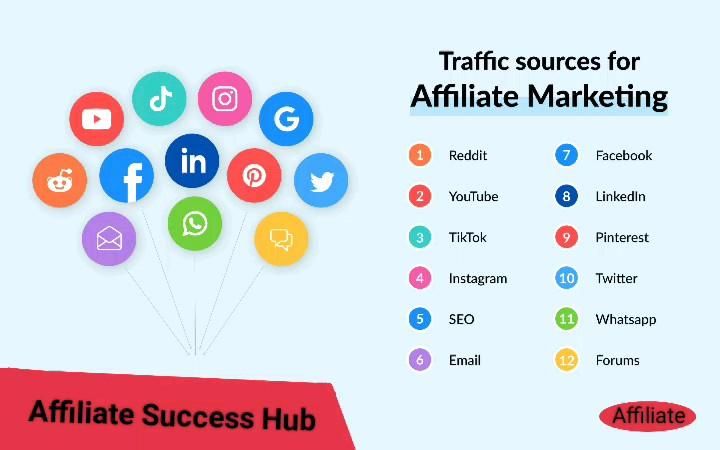
Not every platform fits every kind of affiliate content equally well. Visual and lifestyle niches, from fashion to home decor to travel, tend to thrive on Instagram and Pinterest, where the format itself is built around imagery. Fast-moving, trend-driven content and product discovery fit naturally on TikTok, where short-form video and a highly active discovery algorithm reward frequent, engaging posting. Long-form explainer or tutorial content, along with product comparisons and in-depth reviews, tends to find its best home on YouTube, where viewers already expect and welcome longer engagement.
Rather than spreading yourself thin across every platform from day one, it is generally more effective to master one platform that clearly matches your content style and niche before expanding to others. A single platform where you post consistently and understand the algorithm deeply will outperform a scattered presence across five platforms where you never quite crack what works on any of them.
Building Content Around Genuine Value, Not Just Promotion
The affiliates who grow the largest, most engaged social audiences rarely lead with promotion. Instead, they build a following around a genuinely useful or entertaining content pillar, whether that is budgeting tips, skincare routines, productivity hacks, or home organization, and affiliate recommendations show up as a natural extension of that value rather than the entire point of the account.
A useful mental split is to think about your content in three broad categories: educational content that teaches your audience something, entertaining or relatable content that builds connection and keeps people watching, and promotional content that recommends specific products. Accounts that lean almost entirely on the promotional category tend to plateau quickly, because algorithms and audiences alike reward accounts that provide value beyond a constant stream of product pitches.
Understanding What Actually Drives Growth
Follower count alone is a vanity metric that does not directly translate into affiliate revenue. The metrics that actually predict whether your social growth is translating into income are click-through rate on your bio link or in-post links, conversion rate on whatever landing page you send that traffic to, and earnings per click across your best-performing content. Tracking these numbers weekly, rather than obsessing over follower count, tells you which specific content formats are actually worth doubling down on.
Consistency remains one of the strongest and most controllable growth levers available. Platforms tend to reward accounts that post reliably, since a consistent posting schedule gives the algorithm repeated opportunities to test your content with new audiences. Posting five to seven times a week for a sustained period, rather than posting sporadically whenever inspiration strikes, tends to produce measurably faster growth on most platforms, particularly for newer accounts still establishing an initial audience.
Using a Link-in-Bio Landing Page Instead of a Single Link
Sending every visitor to a single affiliate link forces an all-or-nothing decision that many followers are not ready to make. A link-in-bio landing page, where you organize multiple offers by category and let visitors choose what interests them, tends to lift overall conversion rates because it gives people options rather than a single narrow path. This small piece of infrastructure also lets you track which specific offers are generating the most clicks, information that is invaluable for deciding what to promote more of in future content.
For higher-consideration products, sending traffic directly to a merchant’s page skips an important trust-building step. A short comparison page or simple written explanation of why you recommend one option over its competitors gives undecided followers the reassurance they need before they are ready to click through and buy.
Capturing Attention You Would Otherwise Lose
Most visitors will not buy on their first exposure to a recommendation, no matter how compelling the content. Building a simple system to capture some of that traffic for later follow-up, whether through an email opt-in embedded in your link-in-bio page or a retargeting pixel on any landing pages you control, recovers a meaningful share of interest that would otherwise disappear the moment someone scrolls past your post.
This is one of the clearest advantages that affiliates with an email list layered on top of their social presence have over those relying purely on social platforms. A follower who does not click today might open a follow-up email next week and convert then, whereas a purely social-only strategy has no mechanism to recapture that attention once the moment has passed.
Engaging With Your Audience, Not Just Broadcasting to Them
Social platforms reward accounts that generate genuine interaction, and audiences build trust with creators who actually respond to comments, answer questions, and engage in the community around their content. Setting aside dedicated time to respond to comments and messages, rather than treating posting as a one-way broadcast, both improves algorithmic reach on most platforms and deepens the relationship that ultimately drives affiliate conversions.
User-generated content and audience participation, such as asking followers to share their own experiences with a product category or responding to common questions in dedicated content, also builds a sense of community that keeps people coming back beyond any single viral post.
Repurposing Content Across Formats
Growing an audience does not require creating entirely new content from scratch for every platform and every post. A single piece of core content, such as a product comparison or a how-to guide, can often be reshaped into a short-form video, a carousel post, a longer YouTube explainer, and a newsletter section, multiplying the value of the time invested in the original research and writing.
This kind of repurposing is particularly valuable for affiliates working with limited time, since it allows a smaller content output to reach a wider combined audience across multiple platforms without proportionally increasing the workload.
The Role of Trends Without Losing Your Identity
Participating in trending audio, formats, or challenges can meaningfully boost discovery, particularly on platforms like TikTok and Instagram Reels where trend participation is directly rewarded by the algorithm. However, trend-chasing without any connection to your niche or actual expertise tends to attract the wrong kind of audience, followers interested in the trend itself rather than in you or your recommendations, who are unlikely to convert on any affiliate content you post later.
The most effective approach uses trends as a discovery mechanism while still connecting the content back to your core niche and genuine expertise, so that new followers gained through a trending post are actually a good match for the recommendations you plan to make down the line.
Avoiding Common Growth Mistakes
Posting purely promotional content without any supporting value tends to stall growth quickly, since algorithms and audiences both favor accounts that offer something beyond a constant stream of product pitches. Inconsistent posting undermines the compounding effect that regular content creates, both in terms of algorithmic favor and audience habit formation.
Ignoring your own performance data, and instead guessing at what is working, wastes time on content formats that are not actually driving results. And chasing every available platform simultaneously, rather than building real depth of understanding and consistency on one or two platforms first, spreads effort too thin to produce meaningful growth anywhere.
Building for the Long Term
Sustainable social media growth for affiliate marketing is not about a single viral moment, though a viral post can certainly accelerate growth when it happens. It is about building a consistent, genuinely valuable presence that earns trust over time, tracking the metrics that actually correlate with revenue rather than vanity numbers, and building infrastructure like a link-in-bio page and, ideally, an email list that lets you capture and follow up on the attention your content generates rather than letting it disappear the moment someone scrolls past. Affiliates who approach growth this way tend to build audiences that are smaller on paper than the biggest viral accounts, but far more valuable in terms of actual, sustained affiliate revenue.