Hostinger has spent the last several years transforming itself from “the cheap option” into arguably the best all-around value in web hosting, budget or otherwise. With introductory prices that can drop as low as $1.99 to $2.69 per month on long-term plans, a genuinely fast infrastructure stack, and a custom control panel that many reviewers now prefer over cPanel, Hostinger has earned its position as a top recommendation across nearly every hosting comparison published in 2026. But “cheap” and “good value” aren’t automatically the same thing, so this review takes a close look at what you actually get, what you don’t, and whether Hostinger deserves its reputation as the best budget hosting option on the market.
Hostinger’s Pricing Structure
Hostinger’s headline pricing is aggressive. Long-term subscriptions of 24 or 48 months can bring the Premium shared hosting plan down to somewhere between $1.99 and $2.69 per month, while the Business plan — the tier most reviewers actually recommend for anyone running a real website — typically lands between $2.99 and $3.99 per month on a long-term commitment. Choosing a shorter term, like one month, pushes the price up substantially, often into the $10 to $15 per month range, so the eye-catching low prices you see in ads are tied directly to multi-year commitments.
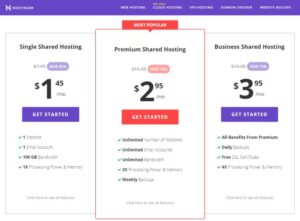
Renewal pricing does increase after your initial term, as it does with virtually every host in this space, but Hostinger’s renewal rates tend to remain more competitive than rivals like Bluehost or SiteGround. That smaller gap between introductory and renewal pricing is a meaningful part of why Hostinger consistently earns “best value” recommendations rather than just “cheapest at signup.”
Beyond shared hosting, Hostinger offers Cloud Startup hosting from around $6.99 to $8.99 per month, WordPress-specific hosting at the same price points as its shared tiers, and VPS hosting starting around $4.99 per month with full root access and KVM virtualization.
What You Get for the Price
This is where Hostinger separates itself from other budget hosts. Rather than cutting corners to hit a low price, Hostinger has invested in genuinely modern infrastructure: LiteSpeed web servers (faster than the Apache setup many competitors still use at this price point), NVMe SSD storage, and AMD EPYC processors across much of its fleet. The result, backed by repeated independent testing, is consistently fast page loads and a 99.9% uptime SLA that reviewers report Hostinger meets or exceeds in practice — testers have recorded 100% uptime in recent 12-month monitoring windows.
The Premium plan supports up to 3 websites with roughly 20GB of NVMe storage, while the Business plan expands that to as many as 50 websites and 100GB of storage — a genuinely generous allowance for the price. All plans include a free SSL certificate, and longer commitments typically bundle a free domain for the first year.
hPanel: Hostinger’s Biggest Usability Win
Instead of the traditional cPanel interface most budget hosts default to, Hostinger built its own control panel called hPanel. It’s cleaner, more modern, and considerably less intimidating for first-time website owners than the dense, decades-old cPanel layout. Reviewers consistently rate hPanel as more intuitive than the industry-standard alternative, which matters a lot if you’ve never managed server settings before. Hostinger has also layered in “Kodee,” an AI assistant integrated into the dashboard that helps with troubleshooting and setup guidance, adding real automation value rather than just a marketing gimmick.
WordPress and WooCommerce Performance
Hostinger’s WordPress hosting includes automatic installation, caching pre-configured for WordPress, and a one-click staging environment on higher plans. For WooCommerce specifically, the Business plan is capable of comfortably handling stores up to roughly 25,000 monthly visitors, while the Cloud Startup plan extends that ceiling to around 200,000 visitors. For high-volume stores running subscription products, multi-currency checkout, or heavy third-party integrations, Hostinger’s Cloud Professional or VPS tiers provide better resource isolation — a sensible upgrade path rather than a hard wall.
Where Hostinger Falls Short
No host is perfect, and Hostinger has a few consistent weak points across independent reviews:
- No phone support. Support is available 24/7 via live chat and email, but there’s no option to call in, which can be frustrating for urgent issues or users who simply prefer talking to a person.
- Pricing display can be confusing. Between multiple hosting types, several plan tiers, and varying subscription lengths, it can take some digging to figure out exactly what you’ll pay, especially once regional VAT is added at checkout.
- Upfront lump-sum billing. The eye-catching low monthly price is paid as a lump sum for the full term upfront, not billed monthly — a detail some new customers miss.
- File count and resource limits still apply, even though marketing language sometimes implies “unlimited” resources; heavy sites can bump into soft caps.
Hostinger vs. the Competition
Against Bluehost, Hostinger wins clearly on price at every stage — both introductory and renewal — while offering comparable or better raw performance thanks to its LiteSpeed and NVMe stack. Against SiteGround, Hostinger is significantly cheaper with a smaller gap between promotional and renewal pricing, though SiteGround’s support quality and geo-redundant backups have an edge for businesses that can justify the extra cost. Against HostGator, Hostinger generally offers faster performance and cheaper long-term renewal pricing, while HostGator holds a slight edge in phone support availability.
Who Should Choose Hostinger
Hostinger is an excellent fit for beginners launching their first website, bloggers and content creators watching their budget, freelancers and small agencies managing multiple client sites, and small to medium WooCommerce stores that don’t yet need enterprise-grade infrastructure. Its combination of low pricing, strong performance, and a genuinely easy-to-use dashboard makes it one of the rare hosts that works well for someone who has never touched a website before and for someone comparing it seriously against premium alternatives on technical merit alone.
It’s a slightly less natural fit if you specifically need phone support for peace of mind, or if you’re running an enterprise-level site that needs dedicated infrastructure and white-glove account management from day one — in those cases, a premium managed host or a dedicated server provider will serve you better.
Final Verdict
Hostinger has earned its reputation as the best budget hosting option in 2026, and honestly, “budget” undersells it a bit — the performance, feature set, and dashboard experience now compete favorably against hosts charging two or three times as much. The combination of genuinely low pricing (both at signup and renewal), fast LiteSpeed-and-NVMe infrastructure, a beginner-friendly custom control panel, and a sensible upgrade path from shared hosting to cloud to VPS makes Hostinger a smart default choice for the vast majority of people starting a new website. If phone support is a dealbreaker for you, look elsewhere — but for nearly everyone else, Hostinger delivers more value per dollar than almost anything else on the market right now.